
No-code & decision-support systems.
Build fast operational tools to structure critical information, streamline workflows, make data usable and strengthen strategic anticipation within existing systems.
Used well, no-code makes critical data visible, reduces operational blind spots, connects scattered flows and gives leaders a clearer view of their priorities.
Critical data
Identify the data that actually influences decisions: suppliers, contracts, countries, partners, sensitive references, deadlines, weak signals, operational statuses.
Workflows & alerts
Turn scattered actions into legible processes: validation, follow-up, alert, status change, monthly review, decision escalation.
Operational interfaces
Build simple interfaces for teams: form, internal portal, filtered view, partner record, contract record, executive dashboard, tracking space.
Decision support
Make arbitration clearer: priorities, critical signals, dependencies, options, risks, actions to take and owners.
Visualise critical data as a decision system
In many organisations, data already exists, but it is scattered across files, emails, contracts, business tools, field feedback and tracking sheets. No-code adds a lightweight governance layer to connect this information, structure workflows and surface priority decisions.
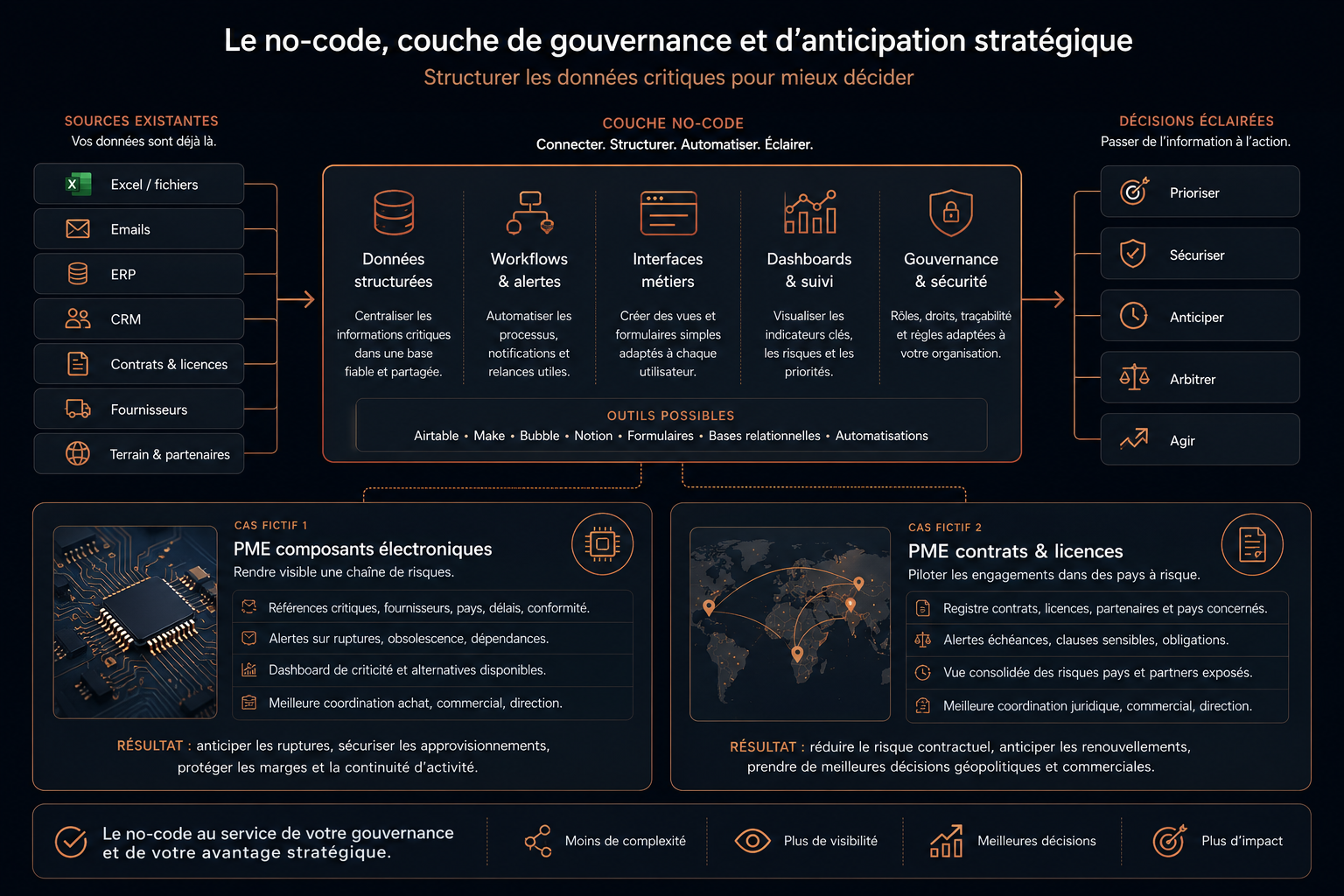
What no-code can bring to an SME or a mid-market company.
Clarity
Move from scattered files to a structured view of critical information.
Responsiveness
Detect a deadline, a disruption, a dependency or a weak signal faster.
Governance
Assign responsibilities, monitor statuses and make decisions traceable.
Anticipation
Connect operational, country, partner, contract and risk data to better prepare arbitration.
Sobriety
Build a useful tool without launching a heavy or expensive IT project.
Organisational learning
Develop a common method around data, decisions and priorities.
A short method: frame, structure, test, hand over.
- Step 1
Framing
Clarify the problem, users, decisions to inform and critical data.
- Step 2
Mapping
Identify existing sources: files, emails, tools, documents, contracts, databases, practices.
- Step 3
Prototype
Create a first useful version: database, form, workflow, dashboard or interface.
- Step 4
Operational test
Test with users, adjust fields, statuses, alerts and views.
- Step 5
Handover
Document the tool, train the team and define governance rules.
You already have the data. What may be missing is the system.
A well-scoped no-code tool can turn scattered information into a monitoring, alert and decision system.