
Secure international decisions in complex environments.
For executives, SMEs, mid-market companies, start-ups and advisory firms exposed to international risk, operational uncertainty and complex market environments.
International developments have become a management issue.
Trade tensions, shipping routes under pressure, regulatory shifts, supplier dependencies and margin pressure: the challenge is not to monitor everything, but to connect signals to decisions, responsibilities and management KPIs.
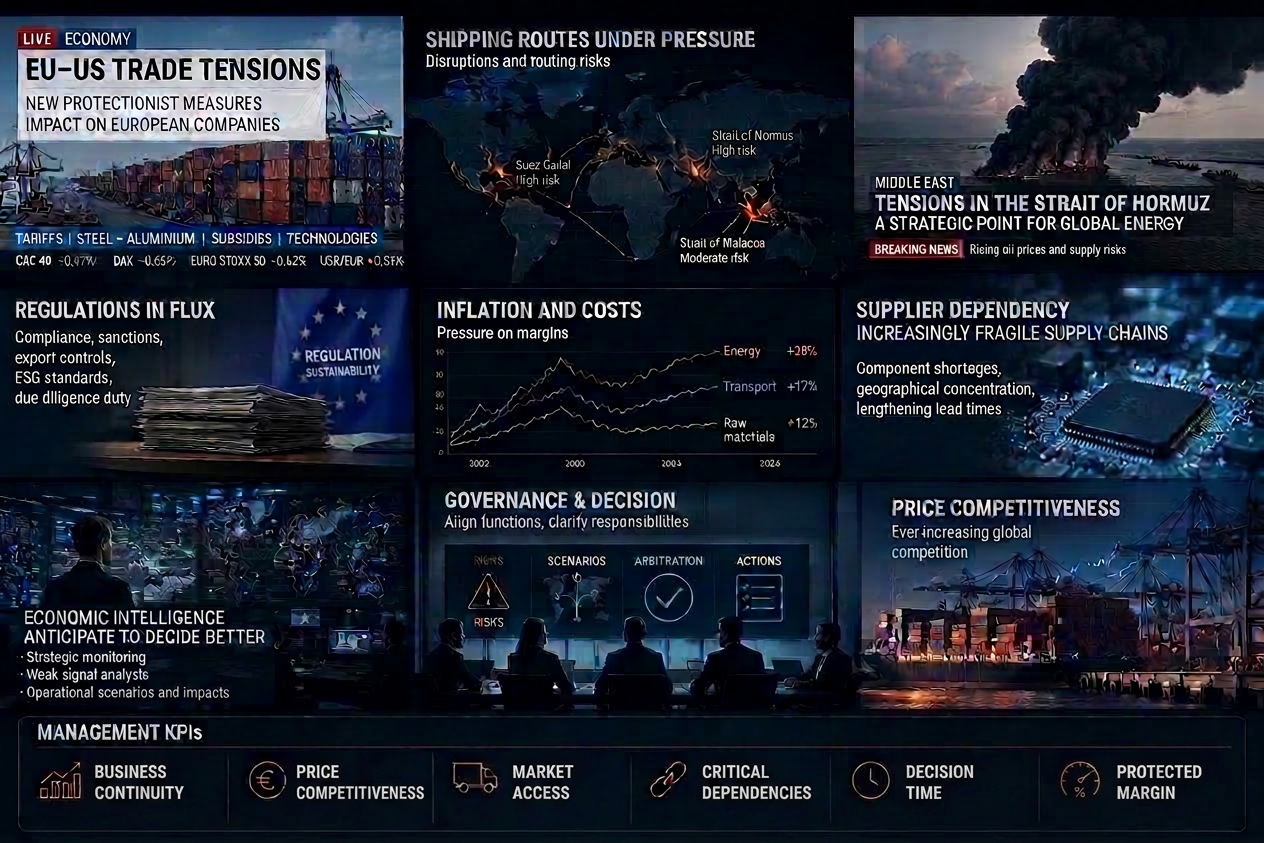
Companies do not lack information. What they often lack is a clear, consolidated and actionable view at executive level.
For an SME or a mid-market company exposed internationally, a poor geopolitical assessment does not stay theoretical. It quickly becomes a steering issue: rising costs, margin loss, delivery delays, regulatory blockages, supplier dependency, loss of price competitiveness or difficulty maintaining activity.
Trade tensions between the European Union and the United States, protectionist measures, customs duties, regulatory constraints, tensions around maritime routes or risks in strategic zones such as the Strait of Hormuz can abruptly change market-access conditions, transport costs, component availability, energy prices or the capacity to honour a contract.
The risk is therefore not only "country" or "geopolitical". It becomes operational: cost, lead time, margin, contract, reputation, business continuity, commercial arbitration and internal governance.
When the environment changes faster than decision rituals, the company loses visibility, responsiveness and room for manoeuvre.
What a poor assessment of the business environment actually costs.
Mispriced commercial decision
The company maintains an offer, a price or a market without integrating the evolution of customs duties, logistics costs or regulatory constraints. Result: margin compression, less competitive offer or poorly calibrated contract.
Delayed decision
Signals exist, but remain scattered between leadership, procurement, sales, legal and operations. Result: decisions arrive too late, when costs are already committed or alternatives narrowed.
Invisible supplier dependency
A supplier, a country, a maritime route, a component or a raw material becomes critical without being identified as such. Result: disruption, delay, last-minute renegotiation or loss of client trust.
Loss of price competitiveness
Competitors adjust their sourcing, pricing or market strategy faster. Result: the company loses competitiveness without immediately understanding whether the problem comes from price, lead time, country risk or market access cost.
Contractual and reputational risk
A commercial commitment is made without integrating country, logistics, regulatory or compliance constraints. Result: delay, dispute, penalty, client tension or reputational damage.
Weak governance
No one knows exactly which signal should trigger a decision, who arbitrates, when to escalate and which KPIs to track. Result: monitoring remains informational, but produces no action.
Two typical situations: when current events become an executive topic.
Exporting industrial SME: preserving market access and price competitiveness.
Profile. Industrial SME of 80 to 150 staff, exporter, with a significant share of revenue outside Europe. It sells equipment, components or technical solutions to international clients, with direct or indirect exposure to the United States, Asia or globalised supply chains.
Situation. Trade tensions, new protectionist measures, customs duty hikes or regulatory constraints gradually change market conditions. Transport, insurance, compliance or component costs rise. Clients demand stable prices while margins shrink.
- understand the actual impact of trade measures on prices;
- know whether costs can be passed on to clients;
- identify exposed suppliers or components;
- anticipate delivery times;
- compare sourcing options;
- avoid losing competitiveness against better-positioned rivals;
- decide quickly without perfectly stabilised information.
- business continuity: share of revenue secured at 12 months;
- price competitiveness: price gap versus key competitors;
- market-access cost: duties, logistics, insurance, compliance;
- critical dependencies: share of suppliers with no qualified alternative;
- decision lead time: time between critical signal and arbitration;
- protected margin: gross-margin evolution on exposed markets.
Governance need. Leadership needs a consolidated view: which signals to monitor, which hypotheses to test, which thresholds trigger action, who arbitrates and which options to prepare.
French Global Pro value. Structure signals, qualify dependencies, connect risk to KPIs and prepare concrete options: renegotiate, secure, diversify, adjust prices, delay or prioritise specific markets.
International mid-market company: securing business continuity in the face of logistics and geopolitical tensions.
Profile. Mid-market company of several hundred staff, present across multiple regions, with suppliers, distributors, clients or subsidiaries in Europe, the Middle East, Asia or North America.
Situation. Tensions around sensitive maritime routes, risks in strategic zones, energy uncertainties, transport delays and insurance costs gradually affect supply and delivery conditions. The company holds information, but it surfaces in fragments: procurement, logistics, finance, legal, operations, countries.
- know which routes or suppliers are genuinely critical;
- measure the potential impact on lead times and continuity;
- anticipate cost rises in transport, energy or insurance;
- arbitrate between stock, alternative sourcing, renegotiation or route change;
- align internal functions around the same view;
- prevent risk management from staying scattered across functions;
- preserve the client relationship despite uncertainty.
- business continuity: critical dependencies with an alternative plan;
- cost of risk: estimated impact on transport, insurance, energy, compliance;
- geopolitical exposure: score by country, route or supplier;
- decision quality: decisions with scenario, impact and action plan;
- governance: review frequency and rate of closed actions;
- escalation time: time between field signal and executive decision.
Governance need. The issue is not only to maintain monitoring. A governance capacity is required: alert thresholds, responsibilities, review rituals, action prioritisation and KPI tracking.
French Global Pro value. Install an operational view of international risk, connect weak signals to business impact, structure arbitration and help leadership maintain activity in an unstable environment.
5 steps to move from monitoring to arbitration.
- 01FrameDecision to secure, actors, constraints, timing.
- 02QualifySources, weak signals, dependencies, partners, vulnerabilities.
- 03AnalyseCountry risk, scenarios, internal/external blockages, impacts.
- 04ArbitrateConcrete options, priorities, alert thresholds, roadmap.
- 05EmbedRituals, dashboard, follow-up, training, no-code system.
Why address these questions now?
SMEs and mid-market companies cannot afford to address international risk only when it becomes visible in costs, delays or margin losses. By then, options are often more limited.
Addressing these questions early helps to:
- preserve business continuity;
- protect margins;
- maintain price competitiveness;
- secure market access;
- anticipate renegotiations;
- reduce critical dependencies;
- align leadership, procurement, finance, legal and operations;
- turn monitoring into actionable decisions.
Six levers to decide, secure and execute.
International risk & operations
Country analysis, partner due diligence, critical supply chain, institutional blockages, reputation, security, decision support.
Sentinel Sprint
Short strategic-anticipation engagement, 4 to 6 weeks.
No-code & decision-support systems
Make, Bubble, Airtable, CRM, dashboards, internal apps, workflows, reporting.
Executive & team training
Operational geopolitics, economic intelligence, risk, intercultural, digital transition, AI / no-code.
International market entry & development
Market analysis, partner qualification, positioning, due diligence and go-to-market for French SMEs and mid-market companies internationally.
Learning expeditions
Field programmes for executives, schools, incubators, clusters: tech, industry, circularity, sovereignty.
Your international risks already exist. The question is which ones deserve a decision.
French Global Pro helps leaders turn scattered signals into a clear view, management KPIs, scenarios and concrete actions.